Cutecore is one of the most joyful, most visually distinctive fashion aesthetics of recent years. Built on pastel palettes, kawaii-inspired motifs, nostalgic childhood imagery, and an unapologetic celebration of all things sweet and soft, it has grown from a Tumblr niche into a genuinely global fashion movement — one that resonates because it offers something rare in modern life: permission to be openly, unself-consciously delighted.
This guide covers everything: what Cutecore actually is, where it came from, the science behind why cute things make us feel good, what to wear, how to build the look from scratch, the Cutecore makeup look, PFPs and digital expression, and how it relates to other aesthetics you might already love.
- What Is Cutecore?
- History and Cultural Roots
- The Science Behind Why Cute Works
- The Cutecore Visual Identity
- The Color Palette
- Key Wardrobe Pieces
- Cutecore Outfit Ideas
- How to Build a Cutecore Look: Step-by-Step
- The Cutecore Makeup Look
- Cutecore PFPs and Digital Aesthetic
- Cutecore vs. Other Aesthetics
- Find Your Cutecore Style (Interactive)
- Frequently Asked Questions
🎀 What Is Cutecore?
Cutecore is a fashion and lifestyle aesthetic built around an intense, joyful celebration of cuteness. It draws on Japanese kawaii culture, childhood nostalgia, pastel color palettes, whimsical motifs, and soft textures to create a visual world that prioritizes warmth, playfulness, and innocent delight over sophistication or edge.
The aesthetic emerged in its recognisable current form primarily on Tumblr and TikTok, and has since spread across Instagram, Pinterest, and Roblox. It sits within the broader kawaii fashion family alongside styles like Lolita, Sanrio-core, and Jirai Kei, but it occupies a distinctly accessible, Western-friendly position — less subcultural than Lolita, less brand-dependent than Sanrio-core, and more wholesome than the darker edges of Jirai Kei.
Importantly, the term "Cutecore" covers a spectrum. At one end is the fully sanitised, wholly wholesome version — soft pastels, strawberry prints, bow accessories, and dewy makeup. At the other end is a darker variant that juxtaposes kawaii imagery with horror or distress motifs. This guide focuses on the mainstream, fashion-forward Cutecore aesthetic that has captured global attention — the sweet, innocent, and joyful version.
📜 History and Cultural Roots
Cutecore does not exist in a vacuum. Its history stretches back decades — to a cultural revolution in Japan that changed how the entire world thinks about cuteness.
Kawaii Culture in Japan
The word kawaii (かわいい) means cute or adorable in Japanese, but its cultural significance runs much deeper than that translation suggests. In the 1970s, kawaii emerged as a genuine social rebellion among Japanese youth — a rejection of rigid social norms and adult expectations through the embrace of childlike, soft, rounded, gentle aesthetics. Young people began writing in rounded, childlike handwriting on purpose. Fashion became softer, more pastel, more deliberately innocent.
A pivotal moment came in 1974 with the creation of Hello Kitty by Sanrio Inc. The character was designed without a mouth specifically so that viewers could project their own emotions onto her blank expression — a deliberate design choice that made her universally relatable and helped export kawaii culture worldwide. By the late 1970s and into the 1980s, kawaii had evolved from a counter-cultural gesture into a pervasive fashion influence, with pastel colors, rounded shapes, and childhood motifs integrated into mainstream Japanese clothing and consumer goods.
Harajuku and Jojifuku
In the 2000s, kawaii elements crystallised into specific Harajuku subcultures. One of the most relevant for Cutecore is Jojifuku — a style rooted in Japanese children's clothing brands, featuring layered skirts, leg warmers worn over patterned tights, platform boots, and garments from beloved children's labels. Jojifuku's influence is directly visible in Cutecore's approach to layering and its love of Japanese children's fashion brands.
Tumblr and the Internet Aesthetic Era
As kawaii culture spread globally through the internet, Western communities on Tumblr began absorbing and reinterpreting these aesthetics. The "-core" naming convention emerged from Tumblr's aesthetic labelling culture — taking a quality and intensifying it into an entire visual world. "Cutecore" in this context meant taking cuteness to its absolute maximum: not just cute clothing, but a fully curated cute environment, cute digital spaces, cute everything.
TikTok and Gen Z
Cutecore's current mainstream form crystallised when TikTok's algorithm began surfacing the aesthetic to Gen Z audiences globally. Creators built entire feeds around the look, sharing outfit videos, room tours, digital art, and makeup tutorials under the Cutecore label. The aesthetic resonated with a generation navigating a difficult period — economic anxiety, social uncertainty — by offering a visually safe, joyful, nostalgic alternative to the harder edges of adult life.
🔬 The Science Behind Why Cute Works
Cutecore is not just a visual preference. There is genuine scientific research explaining why cute aesthetics make people feel better — and why this aesthetic has such strong emotional staying power.
A landmark study from Hiroshima University published in PLOS ONE (NIH/PMC) found that viewing cute images improves task performance, narrows attentional focus, and generates positive emotional responses. The researchers concluded that kawaii things are popular precisely because they produce positive feelings — and that these feelings have measurable behavioural effects.
More recently, a 2025 study published in Brain Sciences (NIH/PMC) by researchers at Kyoto University and the Tokyo Institute of Technology found that kawaii-ness mediates happiness and brain health. The study showed that engagement with cute stimuli can increase happiness and potentially improve brain condition — providing a neuroscientific basis for what Cutecore enthusiasts have always intuitively known: surrounding yourself with cute things genuinely makes you feel better.
Research published in Springer's Kawaii Engineering defines kawaii as "a positive emotion related to the social motivation for engaging and staying with preferable persons and objects." This framing helps explain why Cutecore extends beyond fashion into room decor, digital spaces, and lifestyle — it is about creating an entire environment of positive social and emotional cues.
🎨 The Cutecore Visual Identity
What makes an aesthetic Cutecore rather than simply cute? The answer lies in the deliberate, systematic application of specific visual principles across clothing, accessories, makeup, and digital spaces simultaneously.
Hyper-Sweetness
Cutecore does not do things by halves. Where ordinary cute fashion might include one bow or one pastel piece, Cutecore layers multiple cute elements — a bow headband with a strawberry-print dress with heart-shaped bag with ruffle socks. The effect is intentionally maximalist within the cute register: not a hint of sweetness but an immersion in it.
Childhood Nostalgia
References to childhood are central to the aesthetic. Japanese children's fashion brands, beloved cartoon characters, toys, candy, and childhood symbols (stars, hearts, rainbows, animals) appear throughout. The nostalgia is not ironic — it is sincere. Cutecore genuinely celebrates the emotional safety and joy associated with childhood.
Softness in Every Dimension
Softness operates as a principle across the entire aesthetic: soft colors (pastels rather than saturated brights), soft fabrics (chiffon, tulle, cotton, velvet), soft shapes (rounded, ruffled, puffed), soft motifs (plush animals, clouds, flowers). Even the typography and digital aesthetics associated with Cutecore favour rounded, soft letterforms over sharp or angular ones.
Whimsical Motifs
Hearts, stars, rainbows, strawberries, cherries, bows, clouds, cartoon animals, flowers, and candy appear throughout Cutecore outfits and spaces. These motifs create a consistent visual vocabulary that signals membership in the aesthetic community and reinforces the mood of playful innocence.
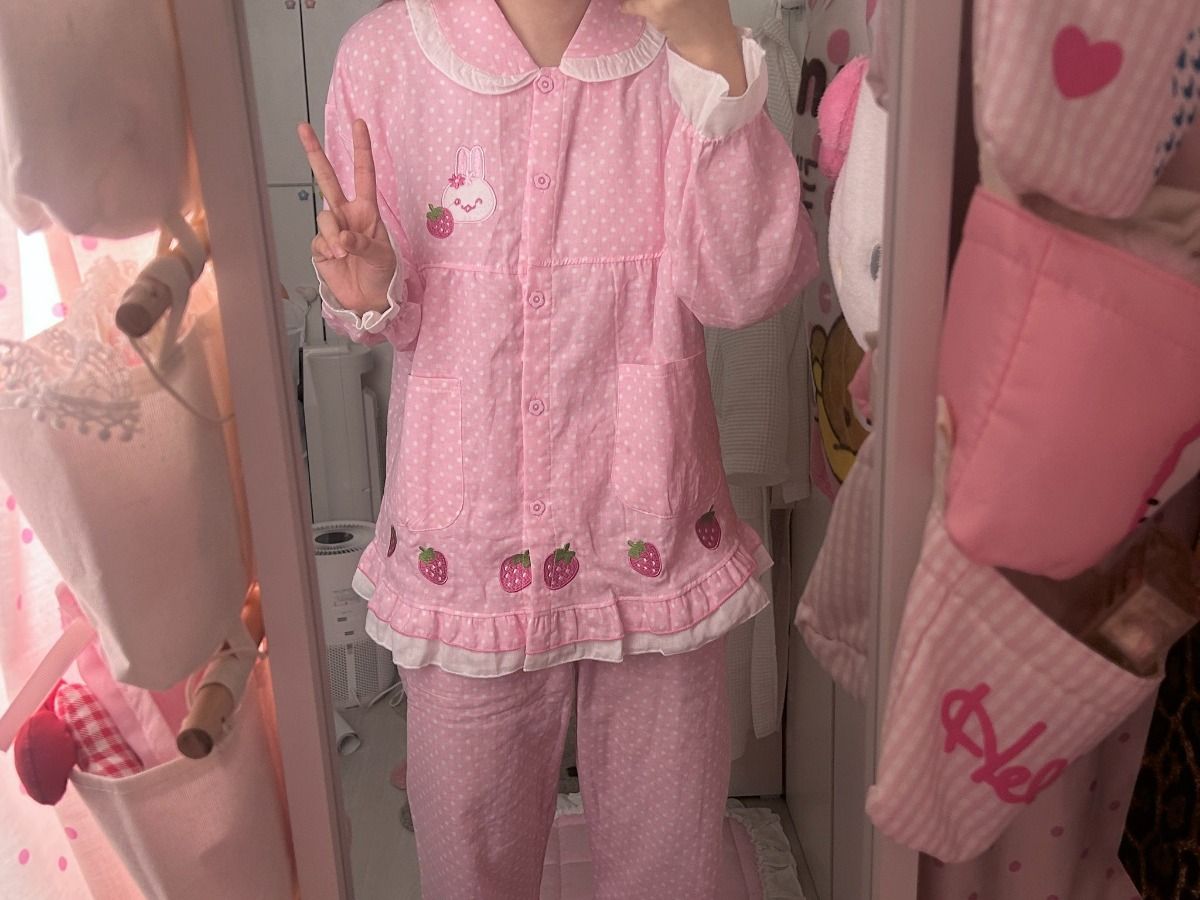
🌸 The Cutecore Color Palette
The Cutecore palette is built on pastels — soft, desaturated colors that feel gentle rather than bold. These are not the muted neutrals of Acubi or the earth tones of Maillard style. They are warm, sweet, and unmistakably feminine in their cultural associations, though the aesthetic itself is open to anyone.
Pink in its many soft variations is the dominant tone, but Cutecore is not a single-color aesthetic. The palette rotates across all pastels, often combining two or three in a single outfit. The key is that every color stays in its softest, most desaturated form. A cobalt blue has no place here — a washed sky blue does. A hot pink does not fit — a dusty rose or baby pink does.
👗 Key Wardrobe Pieces
Accessories
Accessories are arguably more important in Cutecore than in almost any other aesthetic. Hair bows and ribbon headbands, pearl necklaces, star-shaped earrings, heart sunglasses, strawberry hair clips, plushie keychains, and pastel-colored phone cases all contribute to the visual density that defines the look. The rule is more is more — layering accessories in the same pastel palette creates the cumulative cute effect the aesthetic is built on.
✨ Cutecore Outfit Ideas
Click any outfit below to see the full styling breakdown.
🎀 How to Build a Cutecore Look: Step-by-Step
-
1Start with the palette. Every piece in your outfit should be in the pastel range — baby pink, lavender, mint, baby blue, butter yellow, cream, or white. If a piece is too saturated or too dark, it does not belong in this look. The palette is non-negotiable.
-
2Choose your base piece. A puff-sleeve dress, a pleated skirt, or a graphic tee with a cute character. This is the anchor of the outfit. Everything else builds around it.
-
3Add a layering piece. A lace-trim cardigan, a ruffle blouse under a pinafore, or a pastel oversized sweater over a skirt. The layering adds visual softness and depth, and connects Cutecore to its Jojifuku and kawaii layering traditions.
-
4Add socks and shoes. Knee-high socks with lace trim, ruffle ankle socks, or patterned tights. Mary Jane heels, chunky platform sneakers, or pastel boots. The footwear and hosiery combination is one of the most visually distinctive elements of the Cutecore look — do not skip it.
-
5Stack the accessories. Hair bows, ribbon headbands, star or heart earrings, a pearl necklace, a character bag or novelty purse, and pastel-colored phone case or keychain. Unlike Acubi where one accessory is the rule, Cutecore rewards multiple accessories in the same sweet palette.
-
6Add a cute motif element. A strawberry print somewhere, a heart shape, a bow, a plushie keychain, a character graphic. At least one explicit cute motif should be visible — it signals the intentionality of the aesthetic rather than just pale-colored basics.
-
7Finish with the makeup. Dewy skin, soft pink or peach blush placed high on the cheeks, glossy lips, and optionally a soft shimmer on the lids. The makeup should feel fresh and doll-like rather than dramatic. See the full breakdown below.
💄 The Cutecore Makeup Look
🖼️ Cutecore PFPs and Digital Aesthetic
Cutecore is as much a digital aesthetic as a physical one. The community expresses the style through profile pictures, wallpapers, digital edits, icons, and entire online environments styled to match the sweet, pastel world.
Cutecore PFPs
Cutecore profile pictures typically feature soft pastel art, anime-inspired character designs with big eyes and sweet expressions, Sanrio characters, or selfies edited with pastel filters, sparkle overlays, and kawaii sticker elements. The most popular PFP styles include wide-eyed anime characters in pastel outfits, soft-rendered illustrations of girls with bow accessories, and Sanrio character close-ups.
Cutecore Digital Spaces
Discord servers decorated in pink and lavender color schemes, TikTok bios with kaomoji emoticons like (ˆ꒳ˆ) and ✧˖°, Instagram grids styled as consistent pastel palettes, and Pinterest boards curated around the aesthetic all form part of the Cutecore digital world. The typographic style favors rounded, handwriting-inspired fonts, pastel color schemes, and decorative Unicode borders.
Popular Cutecore Motif Icons
The strawberry (🍓), ribbon (🎀), star (⭐), heart (🩷), pudding (🍮) — a reference to the Sanrio character Pompompurin — and bandage (🩹) are the most commonly used Cutecore icons in digital spaces. These signal membership in the community and maintain visual consistency across platforms.
🔄 Cutecore vs. Other Aesthetics
| Aesthetic | Color Approach | Key Vibe | Key Difference from Cutecore |
|---|---|---|---|
| Cutecore | Pastels, soft pinks, all sweet tones | Joyful, innocent, childlike | The reference point |
| Kawaii | Pastels, brights, all cute tones | Cute, playful, Japanese-rooted | Kawaii is broader; Cutecore is a Western intensification of kawaii |
| Coquette | Pale pink, white, neutral | Romantic, flirtatious, soft-feminine | Coquette is more romantic and grown-up; Cutecore is more innocent and childlike |
| Balletcore | Blush pink, white, cream | Graceful, elegant, dancer-inspired | Balletcore is more structured and sophisticated; Cutecore is softer and more playful |
| Sanrio-core | Character-specific palettes | Brand-loyal, character-driven | Sanrio-core relies on specific IP; Cutecore uses broader kawaii motifs without brand dependency |
| Acubi | Neutrals, beige, gray, black | Cool, minimal, intentional | Acubi is neutral and restrained; Cutecore is pastel and maximally sweet |
| Jirai Kei | Black, pink, red accents | Emotionally complex, dark-meets-cute | Jirai Kei juxtaposes cute with dark themes; Cutecore stays wholly wholesome |
🎯 Find Your Cutecore Style
Which Cutecore Direction Fits You?
Answer one question to find your version of the aesthetic.
Which of these sounds most like you when you are getting dressed?
❓ Frequently Asked Questions
Sources and Further Reading
- NIH/PMC — The Power of Kawaii: Viewing Cute Images Promotes Careful Behavior and Narrows Attentional Focus. Nittono et al., PLOS ONE (2012)
- NIH/PMC — Kawaii-Ness Mediates Between Demographic Variables, Happiness, and Brain Conditions. Kokubun et al., Brain Sciences, Kyoto University (2025)
- NIH/PMC — The Construct of Cuteness: A Validity Study for Measuring Content and Evoked Emotions on Social Media (2023)
- Springer — Meaning of Kawaii from a Psychological Perspective. Nittono, H. In: Kawaii Engineering (2019)
- Springer — The Analysis of Kawaii Fashion in Thailand and Japan Using Colorfulness Metrics. Sripian et al. (2020)
- ScienceDirect — Cultural Adaptation of Kawaii in Short Mobile Video Applications (2021)
- Aesthetics Wiki — Cutecore (with sourced citations to platform history and community documentation)
- Wiktionary — Cutecore (etymology and usage documentation, from 1995)